Table of Contents
Installing a new kitchen faucet should be a simple upgrade.
Yet for many homeowners, it turns into a confusing process filled with technical terms, conflicting advice, and disappointing results.
You choose a “standard kitchen faucet,” expecting it to work well for everyday tasks—washing dishes, filling pots, cleaning produce—only to find that it feels underpowered, awkward to use, or poorly matched to your kitchen layout.
In most cases, the issue isn’t poor quality.
It’s a misunderstanding of what “standard” actually means—and how different design, flow, and installation factors affect real-world performance.
This guide breaks down what a standard kitchen faucet truly is, how it’s defined, how it performs in real homes, and how you can choose the right one based on your actual needs, not marketing claims.
What Is a Standard Kitchen Faucet?
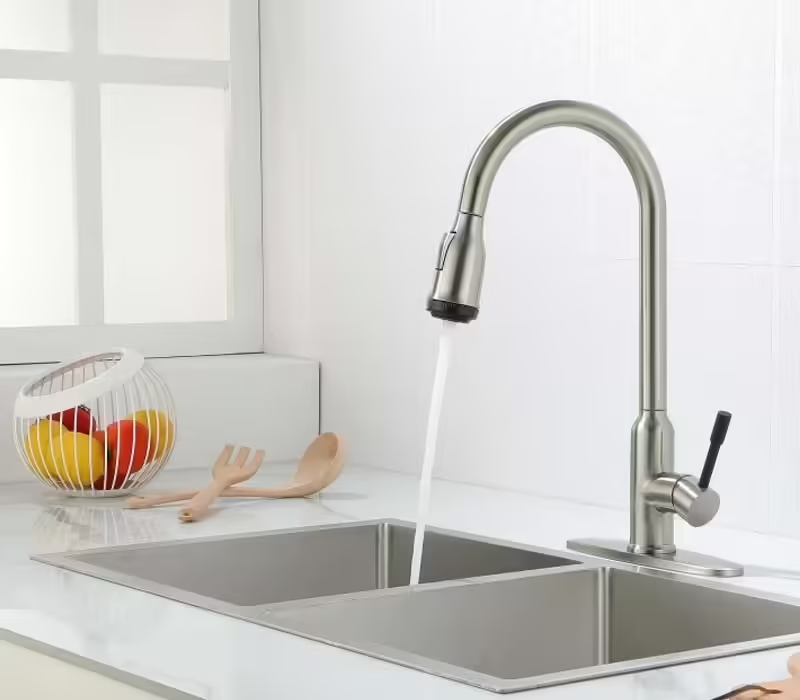
The term standard kitchen faucet” is widely used—but rarely explained clearly.
The Practical Definition of a Standard Kitchen Faucet
A standard kitchen faucet typically refers to a faucet that:
- Fits common sink configurations (1-hole or 3-hole setups)
- Operates within regulated flow rate limits
- Uses conventional installation dimensions
- Is designed for daily residential use, not commercial kitchens
In short, a standard kitchen faucet is meant to work seamlessly with most household plumbing systems without requiring special adapters, high water pressure, or custom cabinetry.
What “Standard” Does Not Mean
A common misconception is that “standard” equals:
- Weak performance
- Basic appearance
- Outdated technology
None of these are inherently true.
“Standard” simply describes compatibility and regulation, not capability.
Why Most Homeowners Choose a Standard Kitchen Faucet
Before diving into specs, it’s important to understand why standard faucets remain the most popular option.
Real User Priorities
Through homeowner surveys and installation feedback, the top priorities are consistently:
- Reliability over novelty
- Easy installation and replacement
- Predictable water flow
- Low maintenance
- Compliance with local plumbing codes
A standard kitchen faucet addresses all five.
Flow Rate Expectations: What Users Actually Experience
Flow rate is one of the most misunderstood aspects of faucet performance.
Typical Flow Rate Range for Standard Kitchen Faucets
| Usage Context | Typical Flow Rate (GPM) |
|---|---|
| Older installations | 2.0 – 2.2 |
| Modern standard faucet | 1.5 – 1.8 |
| Water-efficient homes | 1.2 – 1.5 |
Most standard kitchen faucets today operate between 1.5 and 1.8 GPM, balancing water efficiency and usability.
Why Higher Flow Doesn’t Always Feel Better
Many users assume that more water equals faster work.
In practice:
- Excess flow increases splashing
- Cleaning control decreases
- Water waste rises sharply
A well-designed standard faucet focuses on water shaping, not volume.
Flow vs Pressure: A Common Source of Confusion
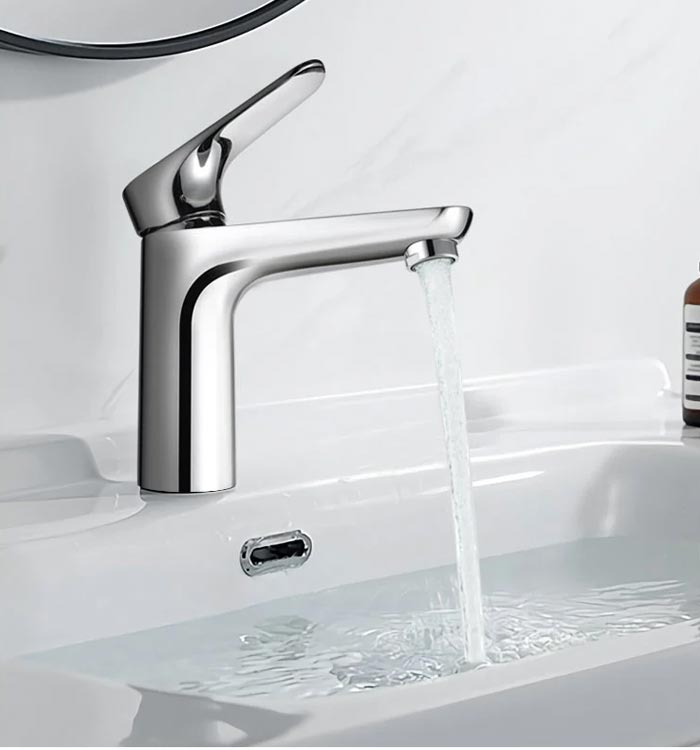
Many homeowners report “low flow” when the real issue is something else.
Understanding the Difference in Plain Terms
- Flow rate = how much water comes out
- Water pressure = how hard it’s pushed
You can have high pressure and low flow at the same time—especially if there’s a restriction somewhere in the system.
Quick At-Home Diagnostic
- If all faucets in your home feel weak → pressure issue
- If only the kitchen faucet feels weak → flow restriction or faucet design
Case Study: Why a “New Faucet” Didn’t Fix the Problem
Household Profile
- Single-family home
- Built in the early 1990s
- Recently remodeled kitchen
Problem
After installing a new standard kitchen faucet, the homeowner noticed:
- Slow pot filling
- Weak rinsing
- Inconsistent spray pattern
Diagnosis
The faucet itself was operating within specifications. The real issues were:
- Partially closed shutoff valve
- Mineral buildup in supply lines
- Old angle stop restricting flow
Result
Once corrected, the same faucet delivered noticeably better performance—without replacement.
Lesson
A standard kitchen faucet can only perform as well as the system feeding it.
Installation Compatibility: Why “Standard” Matters
One of the biggest advantages of a standard kitchen faucet is predictable installation.
Common Sink Configurations Supported
| Sink Type | Faucet Compatibility |
|---|---|
| Single-hole sink | Direct mount |
| Three-hole sink | Deck plate compatible |
| Top-mount sink | Fully compatible |
| Undermount sink | Fully compatible |
This flexibility makes standard faucets ideal for both renovations and replacements.
Handle Design and User Control
Control matters more than most people realize.
Common Handle Types in Standard Faucets
- Single-handle
- Dual-handle
Single-handle faucets dominate because they allow:
- Faster temperature adjustment
- One-handed operation
- Better accessibility
Temperature Stability in Daily Use
A well-built standard kitchen faucet maintains:
- Predictable mixing
- Minimal temperature fluctuation
- Smooth handle movement
This consistency matters during repetitive tasks like dishwashing.
Spray Functions: What Actually Helps Users
Spray features are often over-marketed.
Useful Spray Options in Practice
| Spray Mode | Best For |
|---|---|
| Aerated stream | Filling containers |
| Focused spray | Stuck-on food |
| Wide spray | Rinsing produce |
More modes don’t equal better usability.
Most users rely on two modes, used consistently.
Maintenance Reality: What Homeowners Deal With Long-Term
A standard kitchen faucet is designed for longevity—but maintenance still matters.
Common Maintenance Tasks
- Cleaning the aerator
- Inspecting supply lines
- Occasional cartridge replacement
These tasks are:
- Infrequent
- Inexpensive
- DIY-friendly
This is a major reason many homeowners prefer standard designs over complex alternatives.
Water Efficiency and Regulation Compliance
Modern standard kitchen faucets are built with efficiency in mind.
Typical Compliance Standards
- Federal flow limits
- Local plumbing codes
- Residential water efficiency guidelines
Using a compliant standard faucet protects homeowners from:
- Inspection issues
- Unexpected fines
- Insurance complications
How to Measure Your Faucet’s Real Performance
You don’t need special tools.
Simple Flow Test
- Place a container under the faucet
- Run water at full open
- Time how long it takes to fill 1 gallon
Formula
GPM = (1 ÷ seconds) × 60
This test helps determine whether your faucet—or your plumbing—is the bottleneck.
When a Standard Kitchen Faucet Is the Best Choice
A standard kitchen faucet is ideal if you:
- Want predictable performance
- Prefer easy installation
- Plan future replacements
- Value low maintenance
- Live in a regulated residential area
It’s not about settling—it’s about choosing a solution that fits real life.
When a Standard Faucet Might Not Be Enough
There are situations where users may need something different:
- Extra-deep commercial sinks
- Specialty food prep stations
- Extremely low-pressure homes
Even then, many issues can be resolved without abandoning the standard category.
Final Buying Checklist (User-Focused)
Before choosing a standard kitchen faucet, confirm:
- Sink hole configuration
- Cabinet clearance
- Household water pressure
- Desired spray functions
- Local plumbing requirements
This checklist prevents most post-installation regrets.
Conclusion
A standard kitchen faucet is often misunderstood—not because it lacks capability, but because its performance depends on how well it matches real household conditions.
For most homeowners, a standard faucet delivers exactly what daily kitchen work requires: reliable flow, controlled water delivery, easy installation, and long-term compliance with residential plumbing systems. When chosen thoughtfully, it performs consistently across tasks like dishwashing, food prep, and routine cleaning—without unnecessary complexity or maintenance burden.
FAQ
What flow rate should a standard kitchen faucet have?
Most homeowners are best served by 1.5–1.8 GPM, which balances efficiency and usability.
Does a standard kitchen faucet work with low water pressure?
Yes, but performance depends on internal design and system condition.
Can I increase the flow of my standard faucet?
Cleaning aerators or fixing upstream restrictions is safer than removing flow limiters.
Are standard kitchen faucets outdated?
No. Modern designs focus on efficiency, control, and real-world usability.
How long should a standard kitchen faucet last?
With normal use and basic maintenance, many last 10–15 years or longer.
Is installation DIY-friendly?
Yes. Most standard kitchen faucets are designed for homeowner installation.